
The 15 Best Prospecting Tools for 2026: Prices, Verdicts and What to Skip
By Pitchlane team · March 13, 2024 ·

The best prospecting tools for most B2B teams are GetLeads for contact data, Hunter for verifying addresses, and Sales Navigator for working out who matters inside an account. GetLeads is free for your first 1,000 credits and a flat $497 a month after that, and the other two together are about $170. The prospecting market charges luxury prices for what’s become a commodity, and the money you save belongs in the step every list skips: giving the people on it a reason to answer.
Contact data got cheap. Replies didn’t.
What an email address costs at the entry tier of each lead prospecting tool:
Prices as of November 2026, monthly billing. A credit buys something slightly different at each vendor and phone numbers cost more, but the spread is the point.
| Tool | Entry plan | Credits | Cost per credit |
|---|---|---|---|
| GetLeads | Free, then $497 a month | 1,000 free, then unlimited | Flat fee |
| AeroLeads | $49 one-off | 2,000 | 2.5¢ |
| Hunter | $49 a month | 2,000 | 2.5¢ |
| Snov.io | $39 a month | 1,000 | 3.9¢ |
| Lusha | $49.90 a month | 400 | 12.5¢ |
| ZoomInfo | Quote only | Contract | $33,500 median a year |
At 2.5 cents an address, a 1,000-lead campaign costs $25 to source. Then a realistic 1% of them reply, so 990 people ignore you, and Belkins’ 0.45% across 7.5 million emails says it can be worse. (Instantly’s 3.43% counts auto-replies too.) Teams react by buying more contacts, which doubles the number of people ignoring you.
The fix is upstream and downstream of the data. Upstream, pick 140 accounts you’d love to close over 14,000 you could technically email. Downstream, send each of them something that was obviously made for them. Bram booked 18 meetings from 140 contacts that way.
The 15 prospecting tools, ranked by usefulness
| # | Tool | Best at | From | Verdict |
|---|---|---|---|---|
| 1 | GetLeads | Contact search by title, industry and size, with API and MCP | Free for 1,000 credits, then $497 flat | The default. Start here |
| 2 | Apollo | Contacts, enrichment and sequences in one login | $49 per seat, annual | The alternative when you want one login |
| 3 | Clay | Custom research across many data providers | $185 a month | Best tool here for a real operator |
| 4 | Hunter | Finding and verifying addresses by domain | $49 a month | Cheapest reliable email finder |
| 5 | LinkedIn Sales Navigator | Finding the right person in an account | $119.99 a month | Essential for account-based work |
| 6 | Pitchlane | Turning a list into replies with personalized video | $37 for 250 videos | The step after every tool on this list |
| 7 | Leadfeeder | Showing which companies visit your site | Free; paid from €79 a month, annual | Best warm-list source you already own |
| 8 | Snov.io | Finder, verifier and sender on a budget | $39 a month | Good value, master of none |
| 9 | Pipedrive | Simple pipeline for small sales teams | $14 per seat, annual | Best CRM under 10 reps |
| 10 | HubSpot Sales Hub | CRM shared with marketing | $7 per seat | Best when marketing lives there too |
| 11 | Salesforce | CRM for complex orgs | $25 per user | Overkill until you need it, then essential |
| 12 | ZoomInfo | Deep enterprise data, intent signals | $33,500 median a year | Great data, terrible value for small teams |
| 13 | Lusha | Quick contact lookups from LinkedIn | $49.90 a month | Pricey per credit |
| 14 | Outreach | Prospecting inside an enterprise sales platform | Quote only | A platform purchase, not a prospecting one |
| 15 | AeroLeads | Pay-as-you-go lookups | $49 one-off | Good for a one-time list |
The ones worth paying for
GetLeads
GetLeads is the right first prospecting tool for almost everyone, and the pricing is why. Search a claimed 542M+ contacts by title, industry and company size, each with a full LinkedIn profile, then pull them through the UI, the API, webhooks or an MCP server so Clay or an agent can query the database directly. The free plan is 1,000 credits with no expiry, and Unlimited is a flat $497 a month. No seats, no credits expiring at month end, no arguing over who gets to build lists.
Run your real ICP through the free credits first. It’s a younger vendor than Apollo or ZoomInfo, so coverage in your niche is the one thing to check, and 1,000 credits is enough to find out. If it holds, $497 for unlimited pulls is the cheapest serious data bill on this page once more than one person builds lists. It doesn’t send email, which is fine: your sender does that better anyway.
Apollo
Apollo is the alternative when you want one login for the database, enrichment, sequences and a dialer, at $49 per user on Basic and $79 on Professional. Credits pool across the team and expire at the end of each billing cycle, so don’t buy a seat for every rep: buy them for the one or two people who build lists. Use Apollo’s data, and send from a dedicated sender once volume picks up.
Clay
Clay chains data providers into a waterfall, runs research agents across your list and lets you compute whatever column you can describe: “has a pricing page,” “hiring SDRs,” “uses HubSpot.” It’s how GTM engineers build lists that competitors can’t buy. Launch costs $185 a month and CRM sync arrives with Growth at $495, with Data Credits and Actions metered separately. In the wrong hands it’s a very expensive spreadsheet. In the right hands it’s the strongest prospecting software you can buy.
Hunter
Hunter does one thing well: give it a domain, it returns addresses with confidence scores and sources, and then verifies them. Starter is $49 for 2,000 credits a month, which ties for the cheapest per-credit rate on this list. Pair it with Sales Navigator for account-based work.
LinkedIn Sales Navigator
Sales Navigator is the best way to map a buying committee: who reports to whom, who just joined, who you’re connected to. Core is $119.99 a month. It won’t hand you a verified email address, which is what a cold email campaign actually needs, so it always works alongside a finder like Hunter or Apollo.
Leadfeeder
Leadfeeder identifies which companies are visiting your website by IP, and the free plan shows the last 100 companies with 7 days of history. Paid plans start at €79 a month on annual billing. Companies already reading your pricing page are the warmest cold list you’ll ever get, and most teams never look at it.
The CRMs: where prospects go after they reply
A “prospecting CRM” is mostly a mislabel. The prospecting happens in GetLeads, Hunter and your sender. Your CRM should get the people who replied, booked or engaged, and nobody else. Dump 10,000 cold contacts into HubSpot or Salesforce and your CRM stops telling you who you’re actually in a conversation with.
Pipedrive is the pick under 10 reps, from $14 a seat on annual billing, with a pipeline view your reps will actually keep up to date. HubSpot starts at $7 a seat and is the right call when marketing already runs there; sequences need Professional at $90 a seat plus a $1,500 onboarding fee, and you shouldn’t send cold from your CRM anyway. Salesforce starts at $25 a user on Starter, and Pro Suite is $100. You’ll know when you need it, usually when someone in RevOps asks for a custom object.
The ones we’d skip
ZoomInfo has excellent data and intent signals, and its median contract is $33,500 a year. That’s 67 months of GetLeads Unlimited, or 57 Apollo Basic seats for a year. For an enterprise sales org with phone-heavy outbound, it can pay back. For a team of five, it’s a status purchase.
Lusha is convenient for quick LinkedIn lookups and costs 12.5 cents a credit at the entry tier, five times Hunter’s rate. Snov.io bundles a finder, verifier and sender for $39, which is good value if you want one cheap login, and each part is weaker than the specialist. AeroLeads sells one-off credit packs from $49 that last 12 months, handy for a single list and nothing more. Outreach is a sales engagement platform with a $45,600 median contract, on this list because enterprise teams prospect inside it, and it’s a purchase you make for governance.
What happens after the list: an 83-row import
Every prospecting tool hands you a CSV. What happens next decides whether any of it turns into meetings. This is a real Pitchlane campaign import: 83 rows in, 82 accepted, and one rejected for a data error, with the rejected row and its reason available to download.
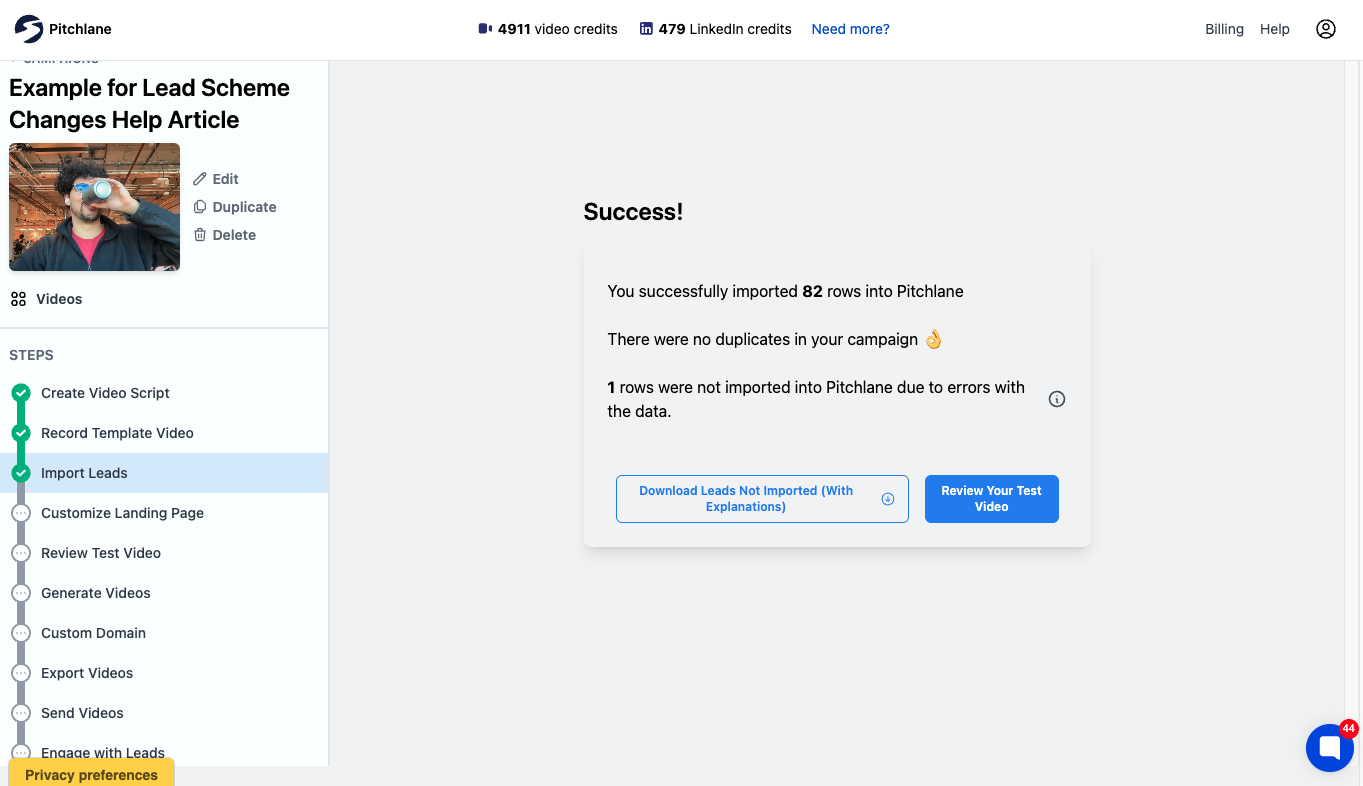
Each of those 82 leads then gets your one recorded pitch playing over their own website, a landing page and a GIF thumbnail, with their name in the email and the video title. The leads go to Instantly or Smartlead directly, or to lemlist, HubSpot, Apollo and 20+ others by CSV, webhook or Zapier.
The trick that makes this work is the URL column. Most teams use the prospect’s homepage. Better operators use Clay to pick a more pointed page per lead: the pricing page, the careers page listing SDR roles, the product they just launched. The prospect sees you talking about the exact page they care about. Read our personalized outreach at scale guide for the full workflow, or compare video prospecting tools.
Lead prospecting tools for each team
A solo founder needs GetLeads on the free plan and nothing else for data. Add Hunter to verify addresses GetLeads can’t. Total: $0 to $49 a month until you’ve used the 1,000 credits, then $497 flat.
A small outbound team needs GetLeads Unlimited for everyone who builds lists, Sales Navigator for whoever runs account-based plays, and Leadfeeder’s free plan for warm accounts. Total: about $620 a month. If that’s too much this quarter, two Apollo Professional seats are $158, with credits that expire.
A team with a GTM engineer should put Clay at the centre, with GetLeads over its API as the main provider and Hunter and Apollo as fallbacks inside the waterfall. That gets you lists nobody else has, which is the only kind of data advantage left.
For email-led teams, our email prospecting tools guide goes deeper on finders and verifiers. For the process side, read the B2B prospecting guide. For senders, see our sales outreach tools ranking, and for the whole stack, our B2B sales tools guide.
Your list is ready. Make it reply.
You’ve already paid for the contacts. Take your next 250 of them, record one pitch, and let Pitchlane put it in front of each prospect with their own website behind you. Start the 14-day trial with 250 videos included, and push the results straight into the sender you already use.
Questions
Frequently asked questions
What is prospecting in CRM?
Prospecting in CRM means tracking potential buyers from first contact until they become a real opportunity. In practice the finding and emailing happen in tools like GetLeads and Instantly, and the CRM should receive the people who replied or engaged, so it stays a list of real conversations.
What is the best prospecting software?
GetLeads is the best prospecting software for most B2B teams: contact search by title, industry and company size, API and MCP access, 1,000 free credits and then a flat 497 dollars a month with no seats. Apollo is the alternative when you want data and sequences in one login, Clay is best for teams with an operator who wants custom research, and Hunter is the cheapest way to find and verify addresses.
What are the top 3 CRM tools?
Salesforce, HubSpot and Pipedrive. Salesforce is for organisations that need custom objects and heavy reporting, HubSpot is for teams where marketing and sales share one database, and Pipedrive is the simplest pipeline for a small sales team, from 14 dollars a seat.
What are the four types of CRM?
Operational, analytical, collaborative and strategic. Operational CRM runs day-to-day customer work like contact records and pipelines, analytical CRM turns customer data into insight, collaborative CRM shares context across teams and partners, and strategic CRM focuses on long-term relationships. Most products cover several types at once; Salesforce publishes a longer explainer on the four.
Is a CRM the same as a prospecting tool?
No. A prospecting tool finds people and contacts them: GetLeads, Apollo, Hunter, Sales Navigator, Instantly. A CRM records the relationship once someone is worth tracking: Salesforce, HubSpot, Pipedrive. Some products do both, but the jobs stay separate, and cold lists belong in the prospecting tool.
Can a small team use a spreadsheet instead of a CRM?
Yes, until two people work the same accounts. A founder with a few dozen live conversations can run on a sheet with a status column and a next-step date. Move to a CRM the first time someone gets contacted twice or a follow-up slips through, and Pipedrive or HubSpot Starter cost less than one lost deal.
What are the best lead prospecting tools for B2B?
GetLeads for contact data, Hunter for verifying addresses, Sales Navigator for mapping who matters inside an account, and Clay if someone on the team will build research tables. Together they produce a list nobody else is emailing. Then add Pitchlane, because a list that gets a 1% reply rate is a cost, not an asset.
Is there a free prospecting tool?
Yes. GetLeads gives 1,000 credits with no expiry on its free plan, enough for a founder's first campaign. Hunter has a free tier with 50 credits a month, Leadfeeder Lite shows the last 100 companies visiting your site for nothing, and Apollo has a free plan limited to Gmail sending. Pay once your first list has proven the ICP.
What is the best sales prospecting tool for a small business?
GetLeads, starting on the free plan and moving to the flat 497 dollars when the 1,000 credits run out. A small business usually has one person building lists, so per-seat tools charge for nothing. Add Hunter at 49 dollars if addresses need verifying, and skip ZoomInfo entirely; its median contract is 33,500 dollars a year.
Apollo vs ZoomInfo: which is better?
Apollo for almost everyone under enterprise scale, at 49 dollars a seat against a 33,500 dollar median contract. ZoomInfo has deeper enterprise data and intent signals that pay back for a phone-heavy sales org. GetLeads beats both on price shape, with unlimited contact search for a flat 497 dollars and API access, once you have confirmed its coverage in your niche.
How much do prospecting tools cost?
An email address costs 2.5 to 12.5 cents at entry tiers: Hunter and AeroLeads at 2.5 cents, Snov.io at 3.9 cents, Lusha at 12.5 cents. GetLeads is 1,000 free credits then a flat 497 dollars a month for unlimited search. Apollo is 49 to 79 dollars a seat. ZoomInfo contracts have a 33,500 dollar median on Vendr.
What is the best prospecting tool for LinkedIn?
Sales Navigator, at 119.99 dollars a month for Core. Nothing else shows you org charts, job changes and shared connections inside a target account. It will not give you a verified email, so pair it with GetLeads or Hunter. For sending LinkedIn messages at volume, Expandi connects to Pitchlane for personalized video in the DM.