
How to Do B2B Sales Prospecting: Your First 30 Days, Day by Day
By Pitchlane team · March 13, 2024 ·

To do B2B sales prospecting, pick 250 people who share one problem, clean their emails, send them four short messages and a video, and call whoever watches. You can have that built in four days and a verdict by day 30. Everything else you’ve read on this topic is a way of putting that off.
This guide is for the person doing the work: an SDR handed a territory, a founder with no pipeline, an agency owner launching a new client. If you’re deciding where the prospecting budget goes, read our B2B prospecting strategy page first. If you’re ready to do it, your Monday looks like this.
Day 1: Write one sentence and buy two domains
Open your CRM and pull your last 20 closed-won deals. If you have none, list the five people you’d most like to sell to and why. Then fill this in:
We help [job title] at [company type] who [situation you can spot from outside] to [outcome they’d pay for].
“We help founders at Series A SaaS companies who just hired their first AE to get that rep to a repeatable pitch in 60 days.” That sentence names who, which companies, how to find them and what you’re selling. If yours can’t do all four, keep going until it can.
Write three disqualifiers next. Too small, wrong CRM, already a customer. Your list gets better when you know who to throw out.
Before lunch, buy two domains close to your main one and create three Google Workspace mailboxes at $8.40 each. Set up SPF, DKIM and DMARC on both. Never send cold from your main domain, because this is the one part of the guide you can’t undo later. Turn on warm-up in your sender today so the clock starts running.
Day 2: Build 250 leads, starting with the warm ones
Your warmest prospects aren’t in any database. Before you open GetLeads, spend an hour on these:
- Champions at past customers who changed jobs
- Lost deals from more than six months ago
- People who follow you, or engaged with your posts, on LinkedIn
- Customers who could introduce you to one peer
Message those by hand, today, because they’ll outperform anything else on this page. One team’s data had LinkedIn messages to an existing network at 11.3% human replies and list-based cold email at 0.3%.
Then build the cold list to reach 250. Filter in GetLeads using your sentence, by title, industry and company size. Its 1,000 free credits cover this whole list twice over, and its API is there for the day you automate this. Apollo works too if you already pay for a seat. Pull one person per company for now, the one whose problem you named. Export, then run the whole file through a verifier such as ZeroBounce, which charges $39 for 2,000. Drop everything marked invalid, and put catch-all addresses in a separate file for later. Across 30 million emails, known-bad addresses bounced at 10.58% and valid ones at 1.21%. Our email prospecting tools guide prices the full stack if you’re starting from nothing.
Add one column you’ll need tomorrow: the URL of each lead’s company website.
Day 3: Write the sequence and record the video
Elite campaigns average under 80 words in the first email and run 4 to 7 touches. Write four emails. This one continues the Series A example, and you should steal the structure while throwing away the words.
Email 1, day 1
Subject: {{first_name}}, your first AE

{{first_name}}, founders who hire their first AE usually
become the bottleneck within a month, because the pitch
still lives in their head.

I recorded a quick video walking through how we fix that,
with {{company}}'s site up behind me:

[thumbnail linking to their video]

Worth 15 minutes next week?
Email 2, day 3. Reply on the same thread. One sentence of proof with a real number from a customer you can name, then the same ask.
Email 3, day 7. Change the angle. If email 1 was about the rep’s ramp, this one’s about the founder’s calendar. Two sentences, and a question they can answer in a word: “Are you still running every demo yourself?”
Email 4, day 12. Offer the thing you’d give away. A template, a teardown, your onboarding doc. “Happy to send it over, no call needed.” Then stop. Instantly’s data has 58% of replies on step one and the other 42% on follow-ups, so the follow-ups earn their place. A fifth bump adds complaints faster than replies.
Check all four in our spam words checker, then record.
The 60-second video script
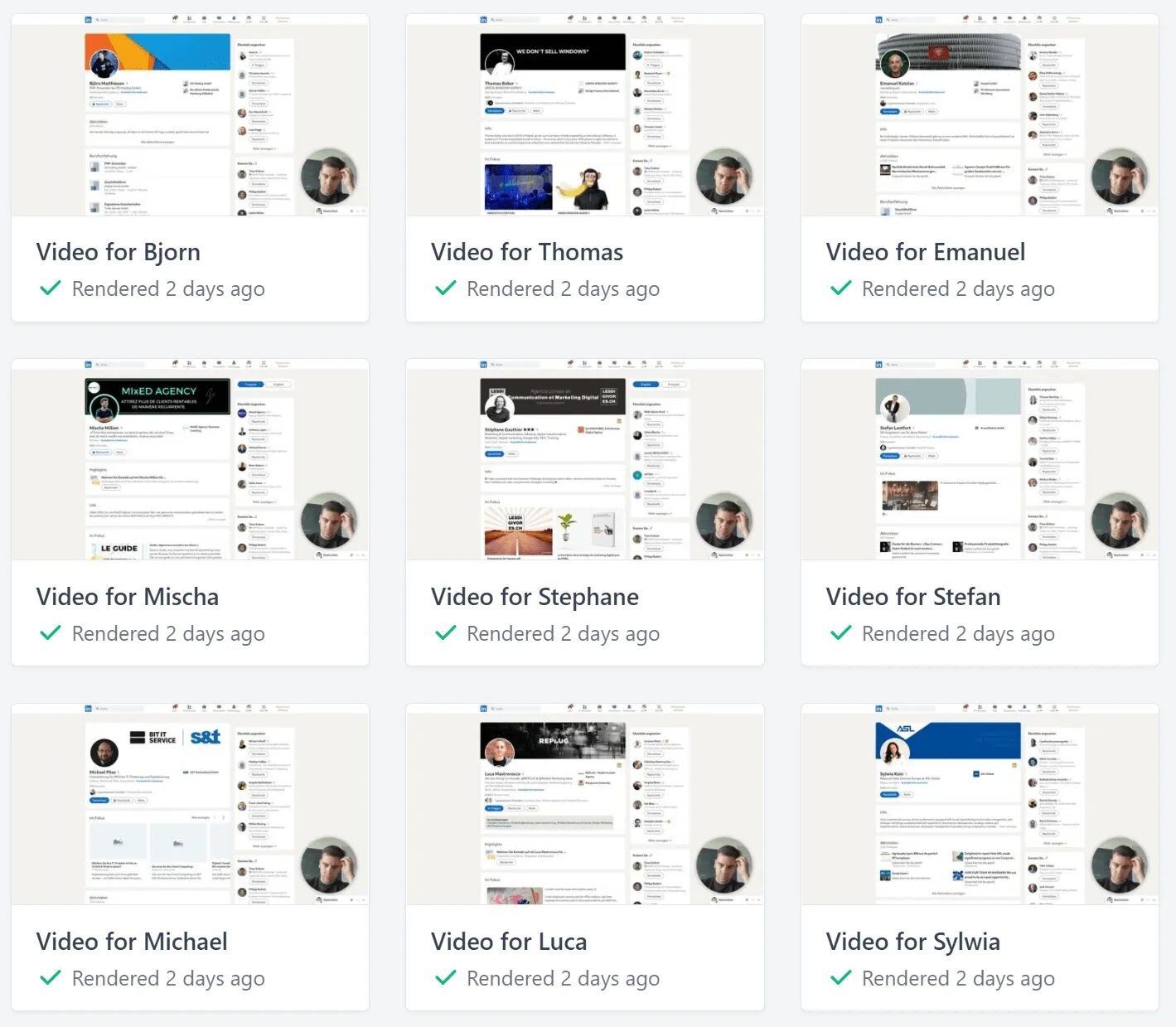
Pitchlane plays one recording over each lead’s own website, so everyone hears the exact same words. Your name for the lead goes in the email and the video title, and the video itself never says it. The craft is writing lines that land for every person in the segment while their own site scrolls behind you:
0–10s, their website behind you. “Hey, I made this for you, and I’ve got your site up here while I talk. Quick reason I’m reaching out.”
10–30s, still their site. “Most founders who’ve just hired their first AE tell me the same thing. Nothing’s wrong with the rep, but the pitch lives in the founder’s head, so every deal still needs them on the call.”
30–50s, switch to a static page with your proof. “We got one team’s first rep closing alone in 60 days. This is what we changed.”
50–60s, static page with your calendar. “If that’s your situation, grab 15 minutes here. If it’s not, reply and tell me I’m wrong.”
Do three takes and use the second, because the first is always stiff and the third has gone flat. A slightly imperfect take is fine, and it proves a person made it. One credit covers up to two minutes, though you won’t need them.
Day 4: Wire it up and send yourself the campaign
Upload your 250 leads and their URLs to Pitchlane, lay out your pages with the first one dynamic, and generate. You’ll get a landing page, a video and a personalised thumbnail for every lead. Push those into your sequence: Instantly and Smartlead connect directly, and lemlist, HubSpot and the rest take them by CSV, webhook or Zapier.
Now send the whole sequence to yourself, on a phone and on a laptop. Click everything. Open three random leads’ videos and look at whether the websites loaded properly. You’d be amazed what a merge-tag error can do to a Monday.
Day 5: Send 10 a day and wait
New domains need patience. Instantly’s guidance is to start at 5 to 10 emails a day per domain and ramp over 4 to 6 weeks. So your three mailboxes begin at about 10 a day each, climbing toward 30 by week four. Total sends across the month land near 1,000, which is what 250 leads times four emails needs.
Add a call task for anyone whose video gets played. A person who watched a minute of you talking over their website is the warmest cold lead you’ll ever have, and most reps let that signal sit in a dashboard. If you do nothing else from this guide, call them the same day.
Weeks 2–4: How to handle every kind of reply
Reply within the hour during the working day, since most of what you’ve built decays quickly. Almost all replies fall into five types, so write these now while you’re calm.
| They say | You say | Then |
|---|---|---|
| “Sure, send times” | Two specific slots and your calendar link | Ask one qualifying question before the call |
| “Not now” | “Makes sense. When should I check back?” | Task on that exact date, remove from sequence |
| “Wrong person” | “Thanks. Who owns this?” | New lead, and mention who sent you |
| “How much?” | A real range, then “depends on X, 15 minutes to scope it?” | Never dodge the question |
| “Stop” | Nothing at all | Suppress them across every tool, immediately |
Before accepting a meeting, ask a single question that would disqualify them, such as “Is your first AE already in seat?” A short calendar of real buyers beats a long calendar of tourists, and it’s the first thing that separates a rep who hits quota from one who books meetings.
Then in the meeting, open with what you noticed about them and ask what made them reply. Their answer is the best copy research you’ll ever get, and it goes straight into next month’s email 1.

Day 30: Read the scorecard
With only 250 leads, single percentages will swing. You’re looking for which step broke, so go down this table and stop at the first row you fail.
| Check | Healthy looks like | If it fails |
|---|---|---|
| Bounce rate | Under 2% | List problem. Re-verify, and drop your data source for this segment if it’s still high |
| Spam complaints | Under 0.10% | Stop sending. Your segment is wrong, or your ask is too aggressive |
| Video plays | People are clicking through | Thumbnail, subject line or deliverability. Test the inbox with a seed account |
| Human replies | Around 1%. 0.45% is the floor, and anything under it means nobody cared | They watched and didn’t care. Rewrite the script around a different problem |
| Positive replies | At least a third of human replies | Your ask is too big, or the segment is curious and not in pain |
| Meetings held | More than the 1 per 871 contacts that plain campaigns produced | Check your no-shows, and tighten the qualifying question |
Change one thing, and run the next 250. Keep the segment if it’s producing and swap it if it isn’t. Most people change the copy when the real problem is that they picked the wrong segment on day 1.
For a sense of what’s possible, Bram booked 18 meetings from 140 contacts and Hoani reached a 5% meeting-book rate at scale. Treat those as their results and not as your day 30 target, but they’re the reason to run this experiment at all.

B2B prospecting tips that didn’t fit a day
Block your prospecting time before the week starts. Reps give it nearly a full day a week and still report no bandwidth, which usually means it’s getting fragmented around everything else.
Keep one owner per lead. Two people emailing one account looks amateur and spikes complaints. Your suppression list should sync across your sender, your CRM and LinkedIn.
Log everything in the CRM from day one. You’ll want the data when you hire your first SDR, and that new hire deserves to start with a segment and a pitch that are already proven.
Pick up the phone for your top 20 accounts. Gong has average reps connecting on 5.4% of dials and booking 4.6% of those, against 13.3% and 16.7% for the top quartile. Video viewers are already warmed up, so those are the calls worth making. Our guide to cold outreach goes further on combining channels.
Start on Monday
Everything above works with plain text, and a plain-text version will teach you plenty. But day 3 is much better with a real video, and it’s free to try: Pitchlane’s 14-day trial includes 250 videos, the exact size of the list you’re building. Record once on Wednesday, and by Friday, 250 people will each get a video with their own website behind you.
Questions
Frequently asked questions
How do you do B2B sales prospecting step by step?
Pick 250 people who share one problem, verify their emails, send four short messages and a personalized video over 12 days, and call whoever plays the video. Build it in four days, send from separate domains, and read a scorecard on day 30. Everything else in the textbooks is a way of putting off those five steps.
What are the steps in the sales prospecting process?
Define the buyer in one sentence, build and clean a list, write a four-email sequence, record one video, send on a ramp, handle replies within the hour, and measure bounces, complaints, human replies and meetings held. The order matters: teams that write copy before they've chosen a segment end up fixing the wrong thing on day 30.
How long does it take to see results from B2B prospecting?
Thirty days for a verdict on one segment, and new domains need four to six weeks of warm-up before full volume. You'll see the first replies in week one, since 58% of replies land on the first email. Don't judge a campaign on week one's numbers; judge which step broke on day 30 and change exactly one thing.
How many emails should a B2B prospecting sequence have?
Four, over about twelve days, which sits inside the 4 to 7 touches Instantly's data found work best. The first email draws 58% of replies and follow-ups the other 42%, so follow-ups earn their place, but each one has to say something new. A fifth bump adds spam complaints faster than it adds replies.
What should a first B2B prospecting email say?
Under 80 words: one sentence naming the problem your segment has, one line of proof, a thumbnail linking to a video with the prospect's own website behind you, and one question. No introduction of yourself and no feature list. Change the angle on every follow-up, and make the last one an offer of something useful with no call attached.
How can a sales prospecting process help my business?
It turns pipeline from luck into a number you can forecast and hand to a new hire. Reps spend nearly a day a week prospecting and 48% still say they lack bandwidth, which is what no process looks like. With a working segment, sequence and scorecard, your first SDR inherits something proven instead of discovering your positioning is wrong, slowly.
What are the best B2B prospecting tips for beginners?
Never send cold from your main domain. Message the people who already know you before you touch a database. Verify every address, because known-bad ones bounce at over 10%. Keep the first email under 80 words. Call anyone who watches your video the same day. And change one variable between campaigns, so you learn something each month.
Should I cold call or cold email first?
Email first, with a video, then call the people who play it. Gong's data puts the average rep at about 402 dials per meeting and the top quartile at about 45, so a cold dial is expensive unless the person is already warm. Someone who watched a minute of you talking over their website is the warmest cold lead you'll get. Call them.
How do I qualify a B2B prospect before booking a meeting?
Ask one question that could disqualify them, such as whether the situation you pitched actually applies, and ask it before you send calendar slots. A short calendar of real buyers beats a long one of tourists. Then open the meeting by asking what made them reply; their answer is next month's first email.
Do I need a CRM to start B2B prospecting?
Yes, from day one, even if it's a free tier. You need one owner per lead, a suppression list that syncs across your sender and LinkedIn, and a record of what each segment produced. The payoff comes when you hire: a new SDR should start with data showing which segment and pitch already work.